


Lessons from Nature: Nothing Is Waste
Updated: Nov 16, 2025
“We may think our garbage has gone away, but in reality we have merely moved it from one place to another. In the natural world there is no waste. The waste, including dead bodies, of one form of life is invariably the food for other forms of life."

(Steven Bouma-Prediger, For the Beauty of the Earth, p. 19)
We live in a throwaway culture.
We eat on paper plates. We drink from foam cups or plastic bottles and sip from toss-away straws. We use paper towels and buy food stored in single-use plastic bags. We get tired of the size or brand or color of our devices or clothes or furniture, and whatever we’re done with, we leave on the street to be taken away. Out of sight, out of mind.
Well, not exactly.
Many of our landfills are reaching capacity. All those plates and devices and sofas have to go somewhere, and in non-landlocked states, they’re not only contributing to overflowing trash heaps on land, but they’re spilling into our waterways and oceans.[i]
Our world is laden with our own trash.
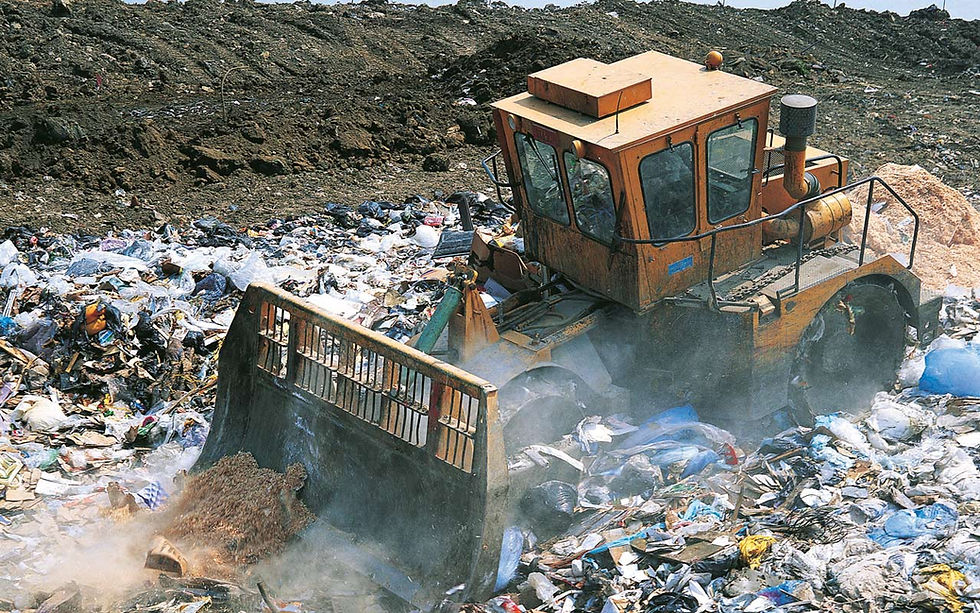
We may not see it, unless we’re unfortunate enough to live close to a place where all the stuff gets dumped (like a neighborhood of veterans in Murfreesboro[ii]), but it’s there. It’s real. And it’s overflowing.
Before we go on, let me say this: I’m not accusing you. I’m accusing myself and anyone else who, like me, spent too many years never considering where my trash is going. I’m questioning all those times I happily dropped bags of trash into our can, feeling great about my clean, tidy space—never considering that my trash has to go somewhere and that my trash is going to collect with others’ and accumulate and that, eventually, other places (and people) will have to sacrifice their ability to be clean or tidy so that, for a time anyway, I may enjoy mine.
I’m part of the problem is what I’m trying to say. I’ve contributed more than my fair share to my community’s trash heap, and while I’m working on cutting back on those contributions, I know there’s plenty of room for improvement.
What Can Be Done? Lessons from Nature
Honestly, I don’t have the answers for how to change a culture. But I do know change begins by being open to other options, and what better place to give our attention than Nature herself?
The natural world, created by our good and loving Father, has lessons all around us, if only we have ears to hear and eyes to see. In the case of accumulating trash and learning to detach from a waste mindset and throwaway world, here’s what Nature might say, if we had the time to stop and listen.
Lesson 1: Stop prioritizing convenience. Start prioritizing your community.

The leaf-cutter ant, believed to have originated in the Amazon and which now stretches into the Americas, got its name from the job that defines its days: cutting and carrying segments of leaves back to its underground home repeatedly.
You would think leaf-cutter ants do this because they eat leaves; but they don’t. In fact, they do this to feed something else—a fungus that lives in their home. The fungus breaks down the leaves, digesting what the ants can’t, and the ants eat the fungus. It’s a symbiotic relationship that depends on both species supporting the other, as opposed to prioritizing only themselves.[iii]
If the leaf cutter ant stopped its work—maybe it’s tired, maybe it’s lazy, maybe it’s busy doing other things—and resorted to eating the fungus without feeding it first, the whole community, after a time, would dry up. Resources would deplete. Life would come to an end.
A waste culture is perpetuated by convenience, by a drive to do what’s easy and a willingness to choose what’s best for me (in the short term) instead of what’s best for me and my community (in the long term).
Lesson 2: Stop craving the new. Start valuing where you are and what you have.

In the White Mountain range of eastern California resides the oldest living tree known to man, a Great Basin Bristlecone Pine nicknamed Methuselah.[iv] This pine was first documented in 1853 and rediscovered in the mid 1950s. After careful study of the tree rings, Methuselah is estimated to be 4,765 years old … “nearly 1,000 years older than any other bristlecone alive today.”[v]
That means this tree was alive when the Christ walked the Earth. A thousand years before that, this tree grew and shed its needles, as it has every day since, when the pyramids were being constructed in Egypt. A thousand years before that, this tree knew a time before people had learned how to make bronze.
What’s impressive about this tree’s longevity, besides the obvious, is its insistence to just keep doing the same, to just do what it was made to do.
Sirach 16 reads, “In the beginning the Lord did his work of creation, and gave everything a place of its own. He arranged everything in an eternal order and decreed that it should be that way forever. … No part [of creation] grows tired or stops its work” (vv. 26-27).[vi]
It's hard for me to even imagine that Methuselah has never been bored … that for 4,000-plus years this tree has just done its work of growing and producing and shedding needles, in the same spot with the same ole view, and that, not once, has it questioned its Maker, who “arranged everything in an eternal order.”
But what if Scripture is right? What if this tree has “never grown tired” and “never stopped its work” simply because it accepts its role, accepts the place given to it by the Creator?
A waste culture is perpetuated by boredom. Often, we don’t need a new car or coat or couch, but we want one because we’re tired of looking at the same ole thing. We hunger for something new. This hunger only grows with every new item we feed it. It becomes incessant, until we’re surrounded by piles of stuff—things that, no matter how promising they once were, continually leave us unsatisfied.
Reenvision, Reclaim, Rethink
Nothing is waste, Nature teaches us. All around, nature is working together, content in its God-given patterns and places and roles. Beyond that, Nature teaches us that when the time comes and something really is past use, that item can be decomposed and reused. That item is not “thrown away,” but repurposed and revalued as an item that, even in its death, contributes to life.

Whatever you see as broken today, even if it be in you, can you ask God for ways to reenvision it? Can you ask Him to help you repurpose it for His glory and the good of our world?
Whatever you are bored with today, can you ask God to help you reclaim it as something valuable and something for which to give thanks?
And whatever work you’re tempted to bypass today because it would be more convenient to choose what’s fast, or cheap, or easy, can you ask God to help you rethink your plan and widen your lens to see the community around you—the ones counting on you, whether they realize it or not, to do what’s best for all of you, today and tomorrow?
Father God, grant us new eyes, new hearts, and new minds to listen to your lessons, given to us in your creation, given to us in Scripture, given to us as a gift. Help us to break away from our culture and root our lives deeply in You.💛
Notes
[i] “Oceans of Trash,” ed. by Bill O’Brian, accessed Nov. 13, 2025, https://www.fws.gov/story/oceans-trash.
[ii] Watch this video about “a smelly landfill in Murfreesboro,” negatively affecting the lives of veterans who live in a neighborhood nearby.
[iii] Jennifer Tsang, Ph.D., “The Leaf-cutter Ant’s 50 Million Years of Farming,” American Society for Microbiology, Sept. 26, 2017, https://asm.org/articles/2017/september/the-leaf-cutter-ant-s-50-million-years-of-farming.
[iv] A reference to the longest-living man recorded in Scripture, who died at 969 years old. See Genesis 5:27.
[v] “Bristlecone Pine,” Bryce Canyon, National Park Service, last updated March 5, 2024, https://www.nps.gov/brca/learn/nature/bristleconepine.htm.
[vi] Good News Translation.


Comments